Saturday, March 1, 2008

Northwest Kyushu - Revisited (Day Three) - Dazaifu

On the third and last day of our trip, Jillian and I went to the Ancient City Dazaifu, where the Tenmangu Shrine (Temple of Knowledge~) that I'd visted before is located. Jillian got to try fresh Umeage Mochi, and we also tried some of the strange soft cream flavors. (Hokkaido Melon and Ume - Plum, nothing as adventurous as Wasabi or Tofu, regrettably)


This time, there was a monkey there. My initial reaction was, "Oh god, poor monkey!" but Jillian assured me that some monkeys actually really like the training, praise, and especially the attention.

Being a Saturday, this day was also another day for a packed temple. Although the time for entrance exams had passed, there's still lots of tourists who come to this spot, although there were slightly less students. (Still lots, though) We made it a point to spend more time exploring the grounds, since I hadn't done as much of that last time.


Here's a picture of an Uso, or Bullfinch, that is famous in Dazaifu. Jill bought a little one with a fortune inside, but it was an unlucky one so she tied the fortune up with the other bad luck ones.
The bullfinches are neat because the little totemy-things that you can buy are supposed to have the power to turn bad luck into good luck.


I really, really wanted to find Tobiume, the legendary plum tree, since I didn't get to see it last time. What I'd learned on this trip is that I had actually found the tree, I'd actually stood next to it for a good ten minutes or so without knowing. The problem was that I simply couldn't read its kanji.
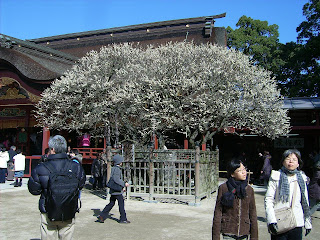

Here it is - the Legendary Tobiume!

The tree actually has different kanji than the kanji used for my car's name, though. (The "ume" is the same, but the "tobi" for my car means "flying" while the tree's means, um... something else) Still - cool to see!
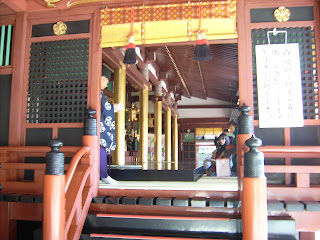

Some people inside the temple
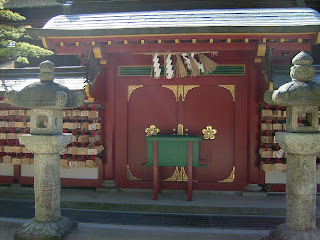
Some tourists were actually able to go into the shrine itself, but the line of people waiting to go in was really long, so we decided to go around the back of the temple instead, where there were more shops and tombs and things.

Around back, there were these wooden wish things, or ema. They had a really cool noise when they were all rattled by the blowing wind

Okay, so now I've got a lot of pictures, and some short comments, so this'll be a string of pictures and captions next. (Show them, don't tell them, and for goodness sake, don't tell them you're telling them! You're breaking the fourth wall! Stop it already!)

Also around the back of the shrine... hey, is that a path back there?
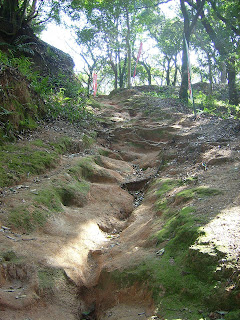

Hey, it is! But what do those signs say? Where does this lead?

What's this staircase? After about twenty minutes of hiking through woodland hills, we climbed up these steps...

Whoa, a secret shrine in the woods! This isn't nearly as busy as Tenmangu... but wait, what about what's behind this shrine?
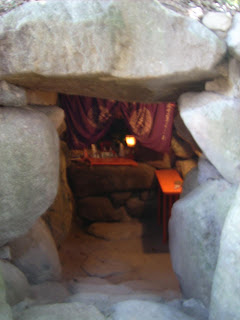
Shock! A third shrine! Behind this little cave was a steep tumble down a hill, so I don't think there was a fourth one behind it, but who knows?

I was really glad that Jillian and I were able to return to Dazaifu, and even more happy that we were able to find the secret, secluded shrine in the woods. Jill commented that Dazaifu kind of reminded her of Leavenworth, where I took her for our six-month Anniversary. In a way, since it's kind of an out-of-the-way place with a social scene completely different from that of Fukuoka, it did seem kind of similar to the little Bavarian tourist town. We both agreed that Kevin, a close family friend, would definitely probably enjoy the natural beauty of the area, which actually made me really homesick. I kind of hope that my family can come to Japan sometime too, but am not sure if they're interested or not. The language barrier would also be undoubtedly difficult, but that's what Jill and I are for, right? There's just so much to experience and taste and see here, but at the very least I'm glad that we can share some of it all with our blogs.

Before catching a bus back to Miyazaki, we decided that it would be good to eat, since we probably wouldn't have a chance to for another five hours or so. Given the choice, I of course chose Okonomiyaki, but this time we were able to make it ourselves!

Whaddya think? Looks pretty good, huh?

Actually, although we had all of the ingredients right in front of us, the fact remained that neither Jill or I actually know how to make Okonomiyaki, so we had a lot of help from one of the waiters. She was really nice about it, and showed us how to mix everything together and the proper flipping technique. She actually did most of the work while Jill and I watched, since we were really hungry, and didn't want to ruin our meal due to lack of proficiency - not knowing how long to cook something is definitely not a good thing! It was of course, delicious.

Whew! So... that's the short story of the trip. We did lots of other stuff too, but I'm trying to cram a lot of things in at once here! Sadly, my trip is coming to an end, and I want to get all of this stuff out there before I return. Things have been really busy lately, (Sean Williams, my gracious professor, warned me about this!) mostly because leaving a place in Japan is much more of an ordeal than simply packing and taking off. Proper farewells need to be made, and everyone has been super kind and hospitable - it's just a little exhausting!

Next up: A New Challenger Approaches! Charlie comes to Miyazaki~~ (Yay!)

Northwest Kyushu - Revisited (Day Two) - Nagasaki

Nagasaki was a Day Trip from Fukuoka for us, (about two hours or so away) but we got a bit of a late start. Jillian was going to be going to Nagasaki with the Miyazaki University GSO (Global Student Organization) again the subsequent weekend, so I didn't want to visit things that she would be visiting again the next week. (Namely, the Atomic Bomb Museum and Peace Memorial)


Nagasaki Skyline from the Bus Station

Instead, we went to Dejima first, which is something I'd studied about back at Evergreen. During the isolation edict put in place by the Tokugawa Shogunate, all foreigners were only allowed to trade on a tiny island off the coast of Nagasaki called Dejima. Most of the traders were Dutch, although some Portuguese lived on the island, too. During the Napoleonic Wars, Dejima was actually the only place in the world to fly the Dutch Flag, since the Netherlands had been conquered by the French. (Or something like that, I think. I'm hazy on that bit of history)

The Dejima Island Recreation

Since the time when the original Dejima existed, the surrounding area has become developed to the point that Dejima isn't an island out in the middle of the sea anymore, but now an island in the middle of a city. The island, run mostly by volunteer tour guides, has recreations of everything from factories to living quarters, and has lots of artifacts and exhibits from the 1800's. They had some comparison now-and-then pictures, and it was really amazing to see just how much the area has changed in just 200 year or so.

A model of Dejima island, um... also on Dejima island

Having been around before the Meiji Area, Dejima also played a major part in advancing Japan's technology, although it was heavily controlled by the Tokugawa Shogunate. Dejima was also the first place that things like glass windows and wallpaper really became readily available in Japan, since it was the only place where such products could be easily made or imported.


Nagasaki's めがね橋 or Meganebashi "Spectacle Bridge" - the oldest stone bridges in Japan. It's called the spectacle bridge because the reflection in the water makes the bridge look kinda like glasses.

Our next stop was Shinchi Chinatown, Japan's oldest Chinese district. Coming here was one of, (but not the only) time that I wasn't sure it would be easier for me to speak to people in English or in Japanese, since a lot of Chinese people in Japan know English.


Bridge into Shinchi Chinatown

All in all, it was actually pretty similar to the International District in Seattle, except being just Chinese, instead of a mix of Asian cultures. The foods there all looked amazing and delicious, and the architecture and artwork were even more stunning.

"Oh, it's that dragon-turtle-serpent thing!" Jill's words, not mine! Apparently this is famous, but I'd never heard of it.

We also wanted to visit at least one temple in Nagasaki, and found one after a bit of an urban hike deep in the heart of Nagasaki.


I'm realizing that I should have done this post sooner after the trip, when our pamphlets were still handy...

This Shrine, um... Shrine X, was a Zen Temple that had been partially destroyed by fire but has since been, um, partially restored. Unexpectedly, they actually had English and, oddly enough, German pamphlets about the history of the temple. To be honest, we came here because on our map, there was a picture of a fish next to this temple, so we thought we were going to see lots of really big koi or something, but no such luck.


They had a really cute garden, but alas... fishless

Since we had a two-hour bus ride ahead of us, we thought that around 5:00 would be a good time to start heading back. On the way, though we noticed that we actually passed a bunch of koi multiple times while walking around.

Oh, there they are!

The koi live in all of the little rivers and creeks that run though Nagasaki, although I have no idea what they eat. Since the day was overcast, it began to get dark before we even got on the bus, but our day didn't end immediately upon our return to Hakata - there was still one other place I wanted to check...


Nakasu-Kawabata: Fukuoka's Entertainment District

Before Jillian came to Japan for her year-long study, we met a lawyer at a benefit party while waitering at my uncles' house for Rosehedge. (Those are my uncles on the "Love without Boundaries" gala card, actually - it's a really good organization, so if you're not familiar with it, check it out!) When he heard that we were going to be going to Japan, he insisted that we go to Fukuoka. "You've got to go to Fukuoka" he told us, but we weren't exactly sure why he wanted us to go. I think this district might have been why.


A row of Yatais - or street restaurants near the river. These popular stalls disappear during the day, and are almost always packed full of people.

Since it was a friday night, this area was PACKED. Businesspeople, tourists, college students, all kinds of people go to Nakasu for its over 2,000 dining, drinking, and um... other stuff-ing establishments.


What's this? Hmm...

If may be hard to read from this pictures, but these are advertisements for "Soap Lands," or als "Men's Baths." These used to be called "Turkish Baths," or "Turkos," but the Turkish Government asked the Japanese Government to call them something else. If you look closely, you'll see that at these bath houses, you can "take a bath" for sixty minutes for about niman yen. (About $200) Hey, wait a minute... $200 for an hour-long bath? What're they charging so much for- oh... I see...

Not all of the places in Nakasu are so lascivious, though. There's plenty of "Host Clubs" and "Hostess Bars," which are advertised by people standing around on the street handing out tissues with their bars address on them. Hostess bars are basically a place where single men, or groups of single men go to drink and be served by women in lingerie. There's probably also some thigh-rubbing and flirting involved, but understanding is that it never goes beyond that. Host clubs are the opposite, cute guys who serve women, but while there's less Host Clubs than Hostess Bars, their numbers are supposedly growing, and it's not always just women who to go Host Clubs, either. (Er... I only know so much about this stuff because it's in the books I've been reading about Japanese Culture. Seriously. I've never actually been to one before, I promise!)

When we finally made our way back to the hostel, we watched Whisper of the Heart, and older Hayao Miyazaki movie about a girl in Tokyo. It's a little difficult to explain, but is really touching. It was from this movie that I learned that John Denver's Country Roads is a commonly known song in Japan, since a Japanese version is taught to students in elementary school.

Jill caught me snoozing

End of day two: Come back next time for our final day of INTENSE, HIGH IMPACT TRAVEL! Yeah!

Northwest Kyushu - Revisited (Day One) - Fukuoka

Literally! My second trip to Fukuoka was even more amazing than the first - in a big way because Jillian was with me. We purchased a man-yen (About $100) Sun-Q ticket that gave us free access to nearly all of Kyushu's buses, including local buses in every city on the southern island.


Some large Japanese buses have stairs down into their lavatories

We arrived in Hakata around noon, and our first initiative was to find somewhere to eat. After a quick bite at Mos Burger, (one of Jill's favorites - kind of an all-natural fast food joint, or something) we headed to Canal City Hakata, which was one of the places I'd wanted to see last time but didn't have a chance to visit.


Canal City Hakata

This pretty mall, while more impressive at night, is a multi-story, multi-building shopping center with a lovely canal running through its middle. Its stores were pretty expensive, and it kind of reminded me of Bellevue Square in Washington, except with a water show. Essentially, they had kind of a scaled-down version of the choreographed fountain show at the Bellagio in Las Vegas. It was lovely, but difficult to photograph.


We also ran into this guy...

Unfortunately for me, the Robot Museum, where you can "touch, see, and experience the cutting edge of robot technology!" has closed down, so when we went to Hakata City Riverrain, we could not see robots. Luckily, Canal City Hakata has two robots, one blue, and one pink. We met the blue one, (above) who could speak Japanese, English, and Chinese! He also liked to have his belly touched, which was equipped with a touch-screen full of information about Hakata Canal City and the surrounding area. He roamed around the mall making R2-D2-esque noises when not occupied.


Moomin Cafe - Moomin is a Finnish character from the 1940's that is really popular here

Before moving on, we treated ourselves to some Baskin-Robbins Ice Cream. It may not seem like a new experience, but Baskin-Robbins in Japan is totally different from America's! Not only do they have some unique flavors that we simply don't have, (like Musk Melon, Popping Shower, and "Matcha" or green tea) but instead of a Flavor of the Month, Japan's flavors are seasonal in that they move in three month cycles. So, in February, you can have the flavors of the month from January, February, and March! Last month, (February) they had Holiday Raspberry Cake, (January) Ghost World, (January) Love Potion 31, (February) Skating Pears, (February) Cherry Blossom, (March) and a bunch more that I can't remember.

Still, despite their wide array of flavors, nothing beats the even more popular soft cream, (soft serve ice cream) served all over in Japan - even at some shrines! See my Dazaifu post from a few weeks ago for an overview of some of those wacky flavors.


Hakataza Kabuki Theatre - Near Hakata Riverrain

Riverrain itself is another huge shopping center, although itself not quite as interesting as Canal City. Nearby are the Hakataza Kabuki and Fukuoka Art Museum, but this time we didn't stop by these two. (Just passed by) Riverrain is full of more expensive shops, and also has a hotel, the closed-down robot museum, and, oddly enough, a little shrine as well.

What's this shrine doing in the middle of a city?

Actually, shrines like these popping up in an urban setting are a pretty common occurrence in Japan, although I prefer the ones in a more secluded, natural setting personally.


Not to be outdone, there are Christian Churches in the city, too

After traipsing around town a while, we decided that it would probably be a good idea to check into our hotel, which was a little hostel near a large park a little ways away from the Fukuoka Castle ruins. Jillian really wanted to go to the Fukuoka City Zoo and Botanical Gardens, so we caught a bus to go check it out.


You've found the map! Now you just need the compass and the dungeon key and you're set...

The zoo in Fukuoka boasts hundreds of animal species, ranging from Canadian Geese to African Elephants. Unfortunately though, one big problem about having a zoo in a large city where there's hardly enough space for people... well, it means that the animals didn't have much space, either.

This pelican's living space is smaller than Jillian's dorm room... I'm not sure who needs more space, though.

Some of the animals, especially the big ones, looked really sleepy and agitated. Jillian, having studied animal behavioral patterns at Evergreen, commented that a lot of them seemed to be pacing around, or performing noticeably repetitive actions. Apparently, this is a sign of boredom.


This kangaroo was extra bored, but at least looked pretty relaxed

Seeing the animals, while fun, was also a little sad. At the Woodland Park Zoo in Seattle, they've kept some of their old cages around from the 70's - empty - with signs explaining how the old cages have become obsolete, and why they've upgraded to new, more enriching environments for the animals. Fukuoka's zoo, however, uses those same cages that Woodland Park has deemed "obsolete." It was a really surprising contrast to the amazing aquarium we'd see in Kagoshima, although this zoo did also have some educational exhibits, too.


A comparison of raptor wing-spans - they have one of those huge ones at the zoo, but he was sleeping.

It's easy for me to say all of these things, though, since I don't know what the financial status of this zoo is or anything like that. I'm sure that if I had a better understanding if what their budgets and things were like, I'd probably be a bit less critical. I'm definitely comfortable saying that I'm probably a bit spoiled when it comes to zoos, since the Pacific Northwest is lucky enough to have a bunch of really nice ones in the area. (Woodland Park, Seattle Aquarium, Point Defiance, Portland, and so on)


Jillian fed this friendly giraffe some bread, provided by a zoo keeper, of course

Despite feeling sorry for the animals, though, we still had a nice time. Because the zoo and botanical gardens closed at 5:00, though, we didn't get a chance to visit the latter. There's always next time, though!


"Wait, Jillian! Please take me with you!"

After the zoo, we made our way back to the hostel on the outskirts of Fukuoka and had an early night - it had been a long day of traveling (over 6 hours total spend on buses and subways!) and we were planning to hop another bus for Nagasaki the next morning.

So... yeah. Nagasaki. That's next!

Friday, February 15, 2008

Do you want to go to the seaside?

I'm not trying to say that everybody wants to go...

Update time! On Wednesday, Jillian and I went to Udo Jingu, or Udo Shrine, which is on the coast about a half hour drive from the university. We hadn't seen Kaori in a little while, so we were happy to go out and visit such a beautiful place with her. (Jill has been to Udo Jingu twice already, and posted about one of her visits here.)


A lovely view of the ocean - you can see some tiny figures fishing on the rocks on the right side of the picture if you look really closely!

We left the college at about two in the afternoon with Kaori, since she'd had a presentation that morning. Along the way, we passed the Devil's Washboard in Aoshima, which I unfortunately couldn't get a good picture of since we were moving. Unlike the sandy beaches of Hawaii or the pebbly beaches of Olympia, the Devil's Washboard is a really unique formation that has a weird sort of angular washboard-like look to it. (It's worth it to Google or Wiki it if you'd like to see a picture)

An observation Jill made about the view was that in Japan, or at least in Kyushu, there isn't really a tree line like in Washington. That is to say, when one looks at the mountains here, they're entirely covered with green. Also, the trees go almost all the way to the water, except where people have developed the land.

Along the way, we almost ran over this little fellow:

Why, hello there!

Luckily, Kaori saw him in time and slowed down. At first, he ran back into his little hole, which gave me the chance to snap this picture. Kaori had never seen one of these before, either. We think that he may have been some kind of たぬき, (TaNuKi - or raccoon dog) but we weren't entirely sure.

Run, run little guy! Whew... he made it across the road safely.

"Raccoon" seems like kind of a poor comparison for these things, since they're very different from the raccoons we usually see around Evergreen. If you're a Mario fan, you might recognize the word "tanuki" from Mario 3, where Mario can don a Tanuk Suit, that makes him look like a raccoon. (Or, maybe you're not a huge nerd and have no idea what I'm talking about. ^^) Actually though, this guy looked kind of weasely... in any case, we can speculate about what he is later.


Ah, Udo Jingu, the shrine by the sea...

Lucky for us, Wednesday was really sunny in Aoshima, although a bit windy. Unlike the last time Jillian, Kaori, Charlie and Max had come here, it was nice and dry out, so the climb down the stairs to the small cavern in a cliff where the shrine is wasn't the slippery, treacherous scramble they'd had to deal with before.


Jill and Kaori at the shrine. Almost more amazing than the structure itself is the cave it resides in - the rock formations are amazingly interesting.

One thing I might not have mentioned before about shrines is that there's always a place where one washes their hands before coming into the grounds. Men also, (if they're brave) are supposed to wash their mouths with the water as well, but not everybody does so.

Udo Jingu has a cool, but scary dragon at its hand-washing pool to ensure 100% cooperation. If one fails to wash, he promptly soaks you with a blast of icy water. (Not really, but wouldn't that be awesome?)

To my surprise, there were a lot of people at the shrine when were there. Not as many as when I went to Dazaifu, but still quite a few. When we asked Kaori about it, she explained that ever since Higashi Sonomanma (remember that guy in the orange robe I wrote about before?) became governor, the tourist trade in Miyazaki prefecture had been revitalized and boosted in a much-needed way. Tourists come to Miyazaki from all over Japan now, whereas it was considered to be kind of a backwater before the new governor came along.


This is a good luck bunny inside the cave.

Jill, Kaori and I pet this bunny on its head for good luck. Jillian's Chinese zodiac is ウサギ、(USaGi - rabbit,) mine is トラ、(ToRa - tiger) and Kaori's is 牛, (うし、UShi, Bull or Cow.) We thought that it was kind of neat that all of our birth signs go in a row! (1985 - Jill, 1986 - Moi, 1987 - Kaori-san) For Jill, this bunny is extra-lucky, I think.

Another thing we saw at the shrine were a bunch of えま、(EMa) which are the flat, wooden things in the picture below. Kaori explained to me that the kanji for ema are the kanji for picture (e) next to the kanji for horse (uma). In some of the books I'm reading for my contract, the authors often state that Japanese people seem to think in pictures, or pictures of words, rather than words. Being exposed to so much kanji here, I'm beginning to understand that a little better, although I can still only recognize and read a few kanji i learned back at Evergreen, along with the ones I see here every day.

There were so many of ema, most likely from students, because this is the college entrance exam time of year. One writes their wishes on the piece of wood, and then hangs it up at the shrine with a little prayer for good luck. Students were hanging these up at Dazaifu, too, but I didn't know what they were then.


The Breast-Rock sign, and lots of 絵馬。

One particular attraction of this cave is the mother's breasts-rocks, which are a section of the rock wall that look kind of like breasts. Expecting mothers and newlyweds come to these rocks to wish for good luck. (I didn't take a picture of the rocks themselves, since they are difficult to photograph well.) It's entirely acceptable to touch the breasts, but I just couldn't bring myself to.

Something that Jill had written about when she visited Udo Jingu the last time is the throwing of rocks into a circle out in a little cove. Kaori was the only one who could manage to make it into the circle before, so I was eager to try it out!


Here is the target where you throw the clay balls. 5 tries for 100円!

What I didn't know until I purchased my tries was that traditionally at Udo Jingu, men are supposed to throw with their left hand, and women are supposed to throw with their right. It's just our luck that Jillian happens to be left-handed, and me right-handed. We got pretty close a few times, and even managed to hit the inside of the circle a few times, but they kept bouncing out or breaking - we just couldn't make it into that little pool of water!


Darn, missed again! The man next to me kept encouraging me, though. He was really nice.

After the shrine, we stopped by the お土産矢 (おみやげや、OMiYaGeYa - souvenir shop) for some soft cream. (Soft-serve ice cream) We each got Hyuganatsu, which is Miyazaki's famous fruit. (A yellow-colored citrus fruit that tastes kind of like a cross between a lemon and an orange) The woman who sold us the ice cream insisted that she give us a larger-than-normal portion, since we spoke English. (We actually ordered in Japanese, but she heard us speaking in English to each other when we were trying to decide which kind of get) We were grateful, but also a little embarrassed. The ice cream was amazing, though. Very light and refreshing, even though it was a cold day.

We also stopped by Kaori's friend Keiko's house, who Jill and Kaori hadn't seen since November. Keiko, a Miyazaki University graduate, had a baby back in September, who is an adorable and energetic baby named Nago-chan.


Kaori, Keiko, Nagomu, Jillian and I - Nago-kun was shy for this picture

Jillian and Kaori were both really surprised at how much Nagomu had grown since the last time they'd seen him. It was my first time meeting Keiko and her baby, but they were both still super nice. Kaori has an amazing talent for stopping Nago-chan from crying, and Jillian's fingers are some of Nagomu's favorite toys.


Aw... isn't he cute? He liked Jillian quite a bit. He was really shy with me, though.

We're hoping to go back to Keiko's in a few weeks to make lunch together, since she really seemed to appreciate the company. (She doesn't get out as often since she's had the baby) Keiko-san's husband works as a driving instructor near the college, so he wasn't home that day.

On the way back to Kibana, Jill saw a monkey and its baby, too! I guess before, Kaori and Jillian had seen a big family of monkeys near Udo Jingu on their last trip. I, unfortunately, missed the monkey because I was looking at the trees, but I did see a monkey that someone was keeping as a pet in their back yard from the train a few weeks ago. (It was jumping, a lot, but not on a bed.)


The only monkeys I saw this time were these road work monkeys -Of course, Japanese barriers have to be cute too, you know.

Later on, we went to pick up Rumi, Kaori's sister from the library at the nursing college, then dropped her off at work in Aoshima. Jill, Kaori and I went out for Okonomiyaki for dinner, (My favorite! Mmm...) and reflected about the trip so far and the weeks to come. It was a lovely lovely day, and spending time with Kaori is always therapeutic. Although we were sad that we couldn't share these times with our friends back at Evergreen that we used to make dinner and spend time with, Kaori seemed to take comfort in knowing that our friend Allison will be coming to study in Kobe soon, and Charlie should be coming to Miyazaki in the next few weeks to visit before returning to the states, too.

Thursday was Saint Valentine's Day, which Jill and I spent together on a little date downtown. The morning was spent cleaning, though, since the International Dormitory at Miyazaki University that Jill lives in had their end-of-semester cleaning day on Wednesday morning. Pretty much everybody that lives here go together to clean all of the common areas like the hals and kitchens. It seemed a little rough to have Valentine's be the cleaning day, but at least it was taken care of in the morning instead of in the evening when people seemed to be busy. (Some girl's on Jill's floor were making home-made chocolates in the kitchen. It smelled amazing!)

An interesting thing about Valentine's Day in Japan is that only women buy chocolates and give them to men, who then give gifts to the women who gave them gifts a month later, on White Day, March 14th. Also, it's almost exclusively called Saint Valentine's Day here, not just Valentine's Day. It is, of course, just as commercialized, if not more so, than in the states. We had a nice, relaxing day on Thursday though, and I received a fantastic care package of Annie's Mac and Cheese, Valentine's Candy, and other tasty comfort snacks from home. (Thanks Mom, Kevin, Tyler, Wilson and Dan!)

Um, that's all for now. I'm sleepy. Next week - Nagasaki, Fukuoka, and I'll (hopefully) finally get around to writing that friendship thing. 'till then!